
Table of contentsAppendices |
6.4 Declarations and Pagination and Layout Formatting ObjectsDeclarations and Pagination and Layout Formatting ObjectsIntroduction[top]IntroductionThe root node of the formatting object tree must be an fo:root formatting object. The children of the fo:root formatting object are a single fo:layout-master-set, an optional fo:declarations, and a sequence of one or more fo:page-sequences. The fo:layout-master-set defines the geometry and sequencing of the pages; the children of the fo:page-sequences, which are called flows (contained in fo:flow and fo:static-content), provide the content that is distributed into the pages. The fo:declarations object is a wrapper for formatting objects whose content is to be used as a resource to the formatting process. The process of generating the pages is done automatically by the XSL processor formatting the result tree. The children of the fo:layout-master-set are the pagination and layout specifications. The names of these specifications end in "-master". There are two types of pagination and layout specifications: page-masters and page-sequence-masters. Page-masters have the role of describing the intended subdivisions of a page and the geometry of these subdivisions. Page-sequence-masters have the role of describing the sequence of page-masters that will be used to generate pages during the formatting of an fo:page-sequence. Page-sequence-masters[top]Page-sequence-mastersEach fo:page-sequence-master characterizes a set of possible sequences of page-masters. For any given fo:page-sequence, only one of the possible set of sequences will be used. The sequence that is used is any sequence that satisfies the constraints determined by the individual page-masters, the flows which generate pages from the page-masters, and the fo:page-sequence-master itself. The fo:page-sequence-master is used to determine which page-masters are used and in which order. The children of the fo:page-sequence-master are a sequence of sub-sequence specifications. The page-masters in a sub-sequence may be specified by a reference to a single page-master or as a repetition of one or more page-masters. For example, a sequence might begin with several explicit page-masters and continue with a repetition of some other page-master (or masters). The fo:single-page-master-reference is used to specify a sub-sequence consisting of a single page-master. There are two ways to specify a sub-sequence that is a repetition. The fo:repeatable-page-master-reference specifies a repetition of a single page-master. The fo:repeatable-page-master-alternatives specifies the repetition of a set of page-masters. Which of the alternative page-masters is used at a given point in the sub-sequence is conditional and may depend on whether the page number is odd or even, is the first page, is the last page, or is blank. The "maximum-repeats" property on the repetition specification controls the number of repetitions. If this property is not specified, there is no limit on the number of repetitions. Page-masters[top]Page-mastersA page-master is a master that is used to generate a page. A page is a viewport/reference pair in which the viewport-area is a child of the area tree root. A page-viewport-area is defined to be the viewport-area of a page, and a page-area is defined to be the unique child of a page-viewport-area. The page-viewport-area is defined by the output medium; the page-area holds the page contents and has the effect of positioning the page contents on the output medium. A single page-master may be used multiple times. Each time it is used it generates a single page; for example, a page-master that is referenced from an fo:repeatable-page-master-reference will be used by the fo:page-sequence to generate one page for each occurrence of the reference in the specified sub-sequence. NOTE: In this specification, there is only one kind of page-master, the fo:simple-page-master. Future versions of this specification may add additional kinds of page-masters. An fo:simple-page-master has, as children, specifications for one or more regions. A region specification is used as a master, the region-master, in generating viewport/reference pair consisting of a region-viewport-area and a region-reference-area. The region-viewport-area is always a child of a page-area generated using the parent of the region-master. NOTE: Each region is defined by a region formatting object. Each region formatting object has a name and a definite position. In addition, the region's height or width is fixed and the other dimension may be either fixed or indefinite. For example, a region that is the body of a Web page may have indefinite height. The specification of the region determines the size and position of region-viewport-areas generated using the region formatting object. The positioning of the viewport is relative to its page-area parent. For version 1.0 of this Recommendation, a page-master will consist of up to five regions: "region-body" and four other regions, one on each side of the body. To allow the side regions to correspond to the current writing-mode, these regions are named "region-before" (which corresponds to "header" in the "lr-tb" writing-mode), "region-after" (which corresponds to "footer" in the "lr-tb" writing-mode), "region-start" (which corresponds to a "left-sidebar" in the "lr-tb" writing-mode) and "region-end" (which corresponds to a "right-sidebar" in the "lr-tb" writing-mode). It is expected that a future version of the Recommendation will introduce a mechanism that allows a page-master to contain an arbitrary number of arbitrarily sized and positioned regions. Some types of region have conditional sub-regions associated with them, and the associated region-reference-areas are divided up by having child areas corresponding to the sub-regions, including a "main-reference-area" for the region. For region-masters to which the column-count property applies, the main-reference-area is further subdivided by having child-areas designated as "span-reference-areas" whose number depends upon the number of spans (i.e. block-areas with span="all") occurring on the page. These in turn are subdivided by having child-areas designated as "normal-flow-reference-areas", whose number depends on the number of columns specified. Page Generation[top]Page GenerationPages are generated by the formatter's processing of fo:page-sequences. As noted above, each page is a viewport/reference pair in which the viewport-area is a child of the area tree root. Each page is generated using a page-master to define the region-viewport-areas and region-reference-areas that correspond to the regions specified by that page-master. Each fo:page-sequence references either an fo:page-sequence-master or a page-master. If the reference is to a page-master, this is interpreted as if it were a reference to an fo:page-sequence-master that repeats the referenced page-master an unbounded number of times. An fo:page-sequence references a page-master if either the fo:page-sequence directly references the page-master via the "master-reference" property or that property references an fo:page-sequence-master that references the page-master. Flows and Flow Mapping[top]Flows and Flow MappingThere are two kinds of flows: fo:static-content and fo:flow. An fo:static-content flow holds content, such as the text that goes into headers and footers, that is repeated on many of the pages. The fo:flow flow holds content that is distributed across a sequence of pages. The processing of the fo:flow flow is what determines how many pages are generated to hold the fo:page-sequence. The fo:page-sequence-master is used as the generator of the sequence of page-masters into which the flow children content is distributed. The children of a flow are a sequence of block-level flow objects. Each flow has a name that is given by its "flow-name" property. No two flows may have the same name. The assignment of flows to regions on a page-master is determined by a flow-map. The flow-map is an association between the flow children of the fo:page-sequence and regions defined within the page-masters referenced by that fo:page-sequence. In version 1.0 of this Recommendation, the flow-map is implicit. The "flow-name" property of a flow specifies to which region that flow is assigned. Each region has a "region-name" property. The implicit flow-map assigns a flow to the region that has the same name. In future versions of XSL, the flow-map is expected to become an explicit formatting object. To avoid requiring users to generate region-names, the regions all have default values for the "region-name" property. The region-body, region-before, region-after, region-start, and region-end have the default names "xsl-region-body", "xsl-region-before", "xsl-region-after", "xsl-region-start", and "xsl-region-end", respectively. In addition, an fo:static-content formatting object may have a "flow-name" property value of "xsl-before-float-separator" or "xsl-footnote-separator". If a conditional sub-region of the region-body is used to generate a reference-area on a particular page, the fo:static-content whose name corresponds to the conditional sub-region shall be formatted into the reference-area associated with the sub-region, as specified in section [pg-out-of-line] . Constraints on Page Generation[top]Constraints on Page GenerationThe areas that are descendants of a page-area are constrained by the
page-master used to generate the page-area and the flows that are assigned
to the regions specified on the page-master. For
fo:flow flows, the areas generated by the descendants of the flow are
distributed across the pages in the sequence that were generated using
page-masters having the region to which the flow is assigned. For
fo:static-content
flows, the processing of the flow is repeated for each page generated
using a page-master having the region to which the flow is assigned
with two exceptions:
for a fo:static-content with a flow-name of
Pagination Tree Structure[top]Pagination Tree StructureThe result tree structure is shown below. 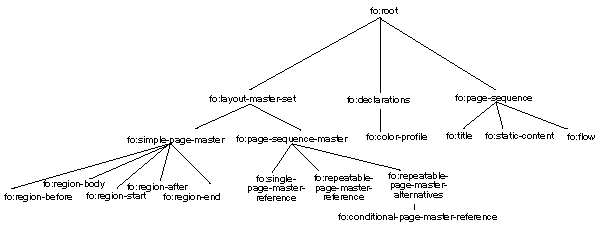
Tree Representation of the Formatting Objects for Pagination fo:root[top]fo:rootCommon Usage: This is the top node of the formatting object tree. It holds an fo:layout-master-set formatting object (which holds all masters used in the document), an optional fo:declarations, and one or more fo:page-sequence objects. Each fo:page-sequence represents a sequence of pages that result from formatting the content children of the fo:page-sequence. NOTE: Areas: Page-viewport-areas are returned by the fo:page-sequence children of the fo:root formatting object. The fo:root does not generate any areas. Constraints: The children of the root of the area tree consist solely of, and totally of, the page-viewport-areas returned by the fo:page-sequence children of the fo:root. The set of all areas returned by the fo:page-sequence children is properly ordered. (See Section [area-genorder] .) Contents: (layout-master-set,declarations?,page-sequence+) The following properties apply to this formatting object: fo:declarations[top]fo:declarationsCommon Usage: The fo:declarations formatting object is used to group global declarations for a stylesheet. Areas: The fo:declarations formatting object does not generate or return any areas. Constraints: None. Contents: (color-profile)+ The fo:declarations flow object may have additional child elements in a non-XSL namespace. Their presence does not, however, change the semantics of the XSL namespace objects and properties. The permitted structure of these non-XSL namespace elements is defined for their namespace(s). fo:color-profile[top]fo:color-profileCommon Usage: The fo:color-profile formatting object is used to declare an ICC Color Profile for a stylesheet. The color-profile is referenced again via the name specified in the "color-profile-name" property. The color-profile is identified by the URI specified in the "src" property value. This URI may identify an internally recognized color-profile or it may point to a ICC Color Profile encoding that should be loaded and interpreted. When the color-profile is referenced (e.g., via the rgb-icc function [expr-color-functions] ), the following rules are used:
Areas: The fo:color-profile formatting object does not generate or return any areas. Constraints: None. Contents: EMPTY The following properties apply to this formatting object: fo:page-sequence[top]fo:page-sequenceCommon Usage: The fo:page-sequence formatting object is used to specify how to create a (sub-)sequence of pages within a document; for example, a chapter of a report. The content of these pages comes from flow children (consisting of the single fo:flow and any fo:static-content flow objects) of the fo:page-sequence. The layout of these pages comes from the fo:page-sequence-master or page-master referenced by the master-reference trait on the fo:page-sequence. The sequence of areas returned by each of the flow-object children of the fo:page-sequence are made descendants of the generated pages as described below. Areas: The fo:page-sequence formatting object generates a sequence of viewport/reference pairs, and returns the page-viewport-areas. For each page-reference-area, and each region specified in the page-master used to generate that page-reference-area, the fo:page-sequence object also generates the viewport/reference pair for the occurrence of that region in that page-reference-area, and may generate a before-float-reference-area, footnote-reference-area, and main-reference-area, and one or more normal-sequence-reference-areas. The generation of these further areas is described in the descriptions of the fo:simple-page-master and region-masters. It may also generate a title-area. All areas generated by an fo:page-sequence have area-class "xsl-absolute". Constraints: Each page-viewport-area/page-reference-area pair is generated using a page-master that satisfies the constraints of the page-sequence-master identified by the master-reference trait of the fo:page-sequence or a page-master that was directly identified by the master-reference trait. The region-viewport-area children of such a page-reference-area must correspond to the regions that are children of that page-master. The areas generated by the fo:page-sequence have as their descendants the areas returned by the flows that are children of the fo:page-sequence. The areas returned to the fo:page-sequence by a flow must satisfy four types of constraints:
If a title-area is generated the following constraints must be satisfied:
The default ordering constraint of section [area-genorder] does not apply to the fo:page-sequence. The default ordering constraints apply to the flow object children inside the single fo:flow; special ordering constraints apply to the child fo:static-content objects. Contents: (title?,static-content*,flow) The following properties apply to this formatting object:
fo:layout-master-set[top]fo:layout-master-setCommon Usage: The fo:layout-master-set is a wrapper around all masters used in the document. This includes page-sequence-masters, page-masters, and region-masters. Areas: The fo:layout-master-set formatting object generates no area directly. The masters that are the children of the fo:layout-master-set are used by the fo:page-sequence to generate pages. Constraints: The value of the master-name trait on each child of the fo:layout-master-set must be unique within the set. Contents: (simple-page-master|page-sequence-master)+ fo:page-sequence-master[top]fo:page-sequence-masterCommon Usage: The fo:page-sequence-master is used to specify the constraints on and the order in which a given set of page-masters will be used in generating a sequence of pages. Pages are automatically generated when the fo:page-sequence-master is used in formatting an fo:page-sequence. NOTE: Areas: The fo:page-sequence-master formatting object generates no area directly. It is used by the fo:page-sequence formatting object to generate pages. Constraints: The children of the fo:page-sequence-master are a sequence of sub-sequence-specifiers. A page-sequence satisfies the constraint determined by an fo:page-sequence-master if (a) it can be partitioned into a sequence of sub-sequences of pages that map one-to-one to an initial sub-sequence of the sequence of sub-sequence-specifiers that are the children of the fo:page-sequence-master and, (b) for each sub-sequence of pages in the partition, that sub-sequence satisfies the constraints of the corresponding sub-sequence-specifier. The sequence of sub-sequences of pages can be shorter than the sequence of sub-sequence-specifiers. It is an error if the entire sequence of sub-sequence-specifiers children is exhausted while some areas returned by an fo:flow are not placed. Implementations may recover, if possible, by re-using the sub-sequence-specifier that was last used to generate a page. Contents: (single-page-master-reference|repeatable-page-master-reference|repeatable-page-master-alternatives)+ The following properties apply to this formatting object: fo:single-page-master-reference[top]fo:single-page-master-referenceCommon Usage: An fo:single-page-master-reference is the simplest sub-sequence-specifier. It specifies a sub-sequence consisting of a single instance of a single page-master. It is used to specify the use of a particular page-master at a given point in the sequence of pages that would be generated using the fo:page-sequence-master that is the parent of the fo:single-page-master-reference. Areas: The fo:single-page-master-reference formatting object generates no area directly. It is used by the fo:page-sequence formatting object to generate pages. Constraints: The fo:single-page-master-reference has a reference to the fo:simple-page-master which has the same master-name as the master-reference trait on the fo:single-page-master-reference. The sub-sequence of pages mapped to this sub-sequence-specifier satisfies the constraints of this sub-sequence-specifier if (a) the sub-sequence of pages consists of a single page and (b) that page is constrained to have been generated using the fo:simple-page-master referenced by the fo:single-page-master-reference. Contents: EMPTY The following properties apply to this formatting object: fo:repeatable-page-master-reference[top]fo:repeatable-page-master-referenceCommon Usage: An fo:repeatable-page-master-reference is the next simplest sub-sequence-specifier. It specifies a sub-sequence consisting of repeated instances of a single page-master. The number of repetitions may be bounded or potentially unbounded. Areas: The fo:repeatable-page-master-reference formatting object generates no area directly. It is used by the fo:page-sequence formatting object to generate pages. Constraints: The fo:repeatable-page-master-reference has a reference to the fo:simple-page-master which has the same master-name as the master-reference trait on the fo:repeatable-page-master-reference. The sub-sequence of pages mapped to this sub-sequence-specifier satisfies the constraints of this sub-sequence-specifier if (a) the sub-sequence of pages consists of zero or more pages, (b) each page is generated using the fo:simple-page-master referenced by the fo:repeatable-page-master-reference, and (c) length of the sub-sequence is less than or equal to the value of maximum-repeats. If no region-master child of the fo:repeatable-page-master has a region-name associated to any flow in an fo:page-sequence, then the sub-sequence is constrained to have length zero. Contents: EMPTY The following properties apply to this formatting object: fo:repeatable-page-master-alternatives[top]fo:repeatable-page-master-alternativesCommon Usage: The fo:repeatable-page-master-alternatives formatting object is the most complex sub-sequence-specifier. It specifies a sub-sequence consisting of repeated instances of a set of alternative page-masters. The number of repetitions may be bounded or potentially unbounded. Which of the alternative page-masters is used at any point in the sequence depends on the evaluation of a condition on the use of the alternative. Typical conditions include, testing whether the page which is generated using the alternative is the first or last page in a page-sequence or is the page blank. The full set of conditions allows different page-masters to be used for the first page, for odd and even pages, for blank pages. NOTE: Areas: The fo:repeatable-page-master-alternatives formatting object generates no area directly. This formatting object is used by the fo:page-sequence formatting object to generate pages. Constraints: The children of the fo:repeatable-page-master-alternatives are fo:conditional-page-master-references. These children will be called alternatives. The sub-sequence of pages mapped to this
sub-sequence-specifier satisfies
the constraints of this sub-sequence-specifier if (a) the
sub-sequence of pages consists of zero or more pages, (b) each page is
generated using the fo:simple-page-master
referenced by the one of the alternatives that
are the children of the fo:repeatable-page-master-alternatives, (c)
the conditions on that alternative are Contents: (conditional-page-master-reference+) The following properties apply to this formatting object: fo:conditional-page-master-reference[top]fo:conditional-page-master-referenceCommon Usage: The fo:conditional-page-master-reference is used to identify a page-master that is to be used when the conditions on its use are satisfied. This allows different page-masters to be used, for example, for even and odd pages, for the first page in a page-sequence, or for blank pages. This usage is typical in chapters of a book or report where the first page has a different layout than the rest of the chapter and the headings and footings on even and odd pages may be different as well. Areas: The fo:conditional-page-master-reference formatting object generates no area directly. It is used by the fo:page-sequence formatting object to generate pages. Constraints: The fo:conditional-page-master-reference has a reference to the fo:simple-page-master which has the same master-name as the master-reference trait on the fo:conditional-page-master-reference. There are three traits, page-position,
odd-or-even, and blank-or-not-blank that
specify the
sub-conditions on the use of the referenced page-master. All three
sub-conditions must be The sub-condition corresponding to the page-position
trait is The sub-condition corresponding to the odd-or-even
trait is The sub-condition corresponding to the blank-or-not-blank trait is
NOTE: Contents: EMPTY The following properties apply to this formatting object: fo:simple-page-master[top]fo:simple-page-masterCommon Usage: The fo:simple-page-master is used in the generation of pages and specifies the geometry of the page. The page may be subdivided into up to five regions: region-body, region-before, region-after, region-start, and region-end. NOTE: NOTE: Areas: The fo:simple-page-master formatting object generates no area directly. It is used in the generation of pages by an fo:page-sequence. When the fo:simple-page-master is used to generate a page, a viewport/reference pair is generated, consisting of a page-viewport-area and a page-reference-area. The page-viewport-area represents the physical bounds of the output medium. The page-reference-area represents the portion of the page on which content is intended to appear; that is, the area inside the page margins. In addition, when the fo:simple-page-master is used to generate a page, viewport/reference pairs that correspond to the regions that are the children of the fo:simple-page-master are also generated. (See the formatting object specifications for the five regions ( [fo_region-body] , [fo_region-before] , [fo_region-after] , [fo_region-start] , and [fo_region-end] ) for the details on the generation of these areas.) 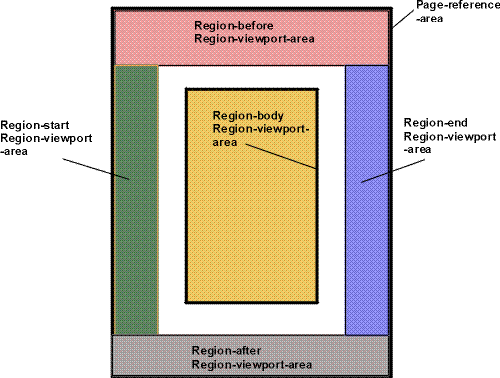
Region-viewport-areas The spacing between the outer four regions and the fo:region-body is determined by subtracting the relevant extent trait on each outer region from the "margin-x" property on the fo:region-body. Trait Derivation: In version 1.0 of this Recommendation, borders and padding are not allowed with a page-reference-area. The remaining traits on the page-reference-area are set according to normal rules for determining the values of traits. Constraints: When a page-master is used in the generation of a page, the block-progression-dimension and inline-progression-dimension of the content-rectangle of the page-viewport-area are determined using the computed values of the "page-height" and "page-width" properties. The traits derived from the margin properties determine the size and position of the content-rectangle of the page-viewport-area. The traits derived from the "margin-top", "margin-bottom", "margin-left" and "margin-right" properties are used to indent the page-reference-area content-rectangle from the corresponding edge of the content-rectangle of the page-viewport-area. Here "top", "bottom", "left" and "right" are determined by the computed values of the "page-height" and "page-width" properties. For sheet media, these values determine the orientation of the sheet; "page-height" is measured from "top" to "bottom". For display media, the display window is always upright; the top of the display screen is "top". NOTE: 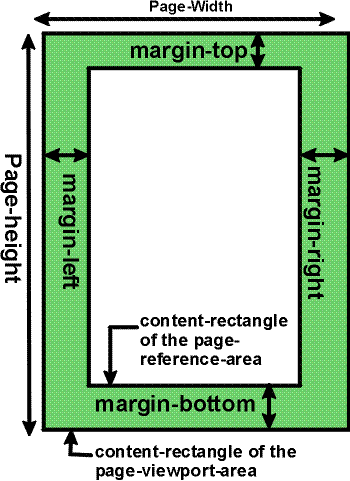
The value of the page-number trait on the first page returned by the fo:page-sequence is constrained to equal the value of the initial-page-number trait. The value of the page-number trait on subsequent pages is constrained to be one greater than the value on the immediately preceding page. The format, letter-value, grouping-separator, grouping-size, country, and language traits are used to format the number into a string form, as specified in XSLT, section 7.7.1. This formatted number is used as the value of the fo:page-number flow object. Constraints applicable to regions: There are a number of constraints that apply to all the regions that are specified within a given fo:simple-page-master. 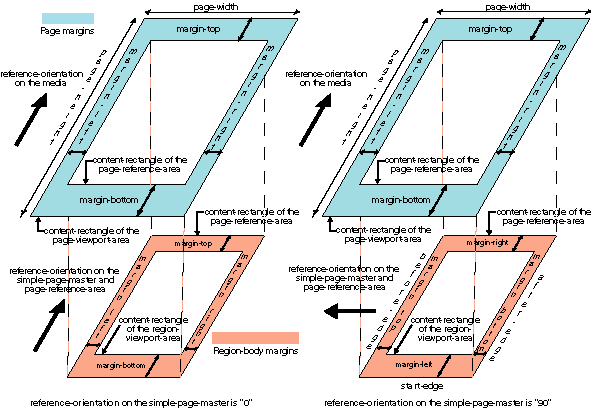
If the block-progression-dimension of the properly stacked region-reference-area is greater than the block-progression-dimension of the region-viewport-area that is its parent, then the constraints on the relationship between the region-viewport-area and the region-reference-area depend on values of the overflow trait on the region-master and the kind of flow assigned to the region. If the flow assigned to the corresponding region is an fo:static-content flow object, then there is no constraint on the block-progression-dimension of the region-reference-area. If the flow assigned to the corresponding region is an fo:flow formatting object, then
Contents: (region-body,region-before?,region-after?,region-start?,region-end?) The following properties apply to this formatting object:
fo:region-body[top]fo:region-bodyCommon Usage: Used in constructing a simple-page-master. This region specifies a viewport/reference pair that is located in the "center" of the fo:simple-page-master. The overflow trait controls how much of the underlying region-reference-area is visible; that is, whether the region-reference-area is clipped by its parent region-viewport-area. NOTE: NOTE: The fo:region-body may be also be used to provide multiple columns. When the column-count trait is greater than one, then the region-body will be subdivided into multiple columns. Areas: The fo:region-body formatting object is used to generate one region-viewport-area and one region-reference-area whenever an fo:simple-page-master that has an fo:region-body as a child is used to generate a page. A scrolling mechanism shall be provided, in an implementation-defined manner, if the value of the overflow trait is "scroll". The position and size of the region-viewport-area is specified relative to the content-rectangle of the page-reference-area generated by fo:simple-page-master. The content-rectangle of the region-viewport-area is indented from the content-rectangle of the page-reference-area by the values of the "margin-top", "margin-bottom", "margin-left" and "margin-right" properties. In version 1.0 of this Recommendation, the values of the padding and border-width traits must be "0". The region-reference-area generated using an fo:region-body is the child of the region-viewport-area. The reference-orientation trait of the fo:region-body is used to orient the coordinate system of the region-reference-area generated by the fo:region-body relative to the coordinate system of the page-reference-area generated by fo:simple-page-master (and, therefore, relative to the viewport positioned in that latter coordinate system). In addition to the viewport/reference pair, when the region-body is used to generate areas, at least one and up to three additional reference-areas are generated. These reference-areas are the optional before-float-reference-area, the optional footnote-reference-area, and the main-reference-area. The latter reference-area comprises the space left after space is borrowed for the other two reference-areas. The main-reference-area has no padding, border, or space associated with it. NOTE: The main-reference-area has as its children a sequence of span-reference-areas. These are reference-area block-areas with zero border and padding, whose inline-progression-dimension is equal to that of the main-reference-area, and which are normally stacked within the main-reference-area. Each span-reference-area has one or more reference-area children, designated as normal-flow-reference-areas. The number and placement of the children of a span-reference-area depends on the column-count trait of the span-reference-area. In turn, the formatter must generate precisely enough of these span-reference-areas, and so set their column-count traits, that block-areas returned from the fo:flow with a span of "all" are children of span-reference-areas with column-count equal to 1, and block-areas returned from the fo:flow with a span of "none" are children of span-reference-areas with column-count equal to the refined value of the column-count property of the associated region-reference-area. For each span-reference-area, the number N of normal-flow-reference-area children is equal to the value of the column-count trait. It is an error to specify a column-count other than 1 if the "overflow" property has the value "scroll". An implementation may recover by behaving as if "1" had been specified. The inline-progression-dimension of each of these normal-flow-reference-areas is determined by subtracting (N-1) times the column-gap trait from the inline-progression-dimension of the main-reference-area and dividing that result by N. Using "body-in-size" for the name of the inline-progression-dimension of the span-reference-area and "column-in-size" for the name of the size of the normal-flow-reference-areas in the inline-progression-direction, the formula is: column-in-size = (body-in-size - (N - 1)*column-gap)/N The block-progression-dimension of the normal-flow-reference-areas is the same as that of the parent span-reference-area. NOTE: The normal-flow-reference-areas are positioned within the span-reference-area as follows: The first column is positioned with the before-edge and start-edge of its content-rectangle coincident with the before-edge and start-edge of the content-rectangle of the span-reference-area. The content-rectangle of the Jth normal-flow-reference-area child of the span-reference-area is positioned with its before-edge coincident with the before-edge of the content-rectangle of the span-reference-area and with is start-edge at ((J-1)*(column-in-size + column-gap)) in the inline-progression-direction. This results in the end-edge of the content-rectangle of the Nth normal-flow-reference-area being coincident with the end-edge of the content-rectangle of the span-reference-area. NOTE: All areas generated by using the fo:region-body are of area-class "xsl-absolute". Trait Derivation: The reference-orientation of the region-viewport-area is taken from the value of the reference-orientation trait on the region-master which specifies the region. reference-orientation of the region-reference-area is set to "0" and is, therefore, the same as the orientation established by the region-viewport-area. The remaining traits on the region-viewport-area and region-reference-area are set according to normal rules for determining the values of traits. The traits on the span-reference-areas and on the normal-flow-reference-areas are determined, in the same manner as described in [refinement] , from a set of properties where each property has its initial value except for reference-orientation, writing-mode, and display-align that have the value from the fo:region-body. Constraints: The constraints applicable to all regions (see [fo_simple-page-master] ) all apply. The inline-progression-dimension of the region-viewport-area is determined by the inline-progression-dimension of the content-rectangle of the page-reference-area minus the values of the start-indent and end-indent traits of the region-master. The start-edge and end-edge of the content-rectangle of the region-viewport-area are determined by the reference-orientation trait on the page-master. The block-progression-dimension of the region-viewport-area is determined by the block-progression-dimension of the content-rectangle for the page-reference-area minus the values of the space-before and space-after traits of the region-master. The before-edge and after-edge of the content-rectangle of the region-viewport-area are determined by the reference-orientation trait on the page-master. The values of the space-before and start-indent traits are used to position the region-viewport-area relative to the before-edge and start-edge of the content-rectangle of the page-reference-area. The constraints on the size and position of the region-reference-area generated using the fo:region-body are covered in the "Constraints applicable to regions" section of [fo_simple-page-master] . Contents: EMPTY The following properties apply to this formatting object:
fo:region-before[top]fo:region-beforeCommon Usage: Used in constructing a simple-page-master. This region specifies a viewport/reference pair that is located on the "before" side of the page-reference-area. In lr-tb writing-mode, this region corresponds to the header region. The overflow trait controls how much of the underlying region-reference-area is visible; that is, whether the region-reference-area is clipped by its parent region-viewport-area. Areas: The fo:region-before formatting object is used to generate one region-viewport-area and one region-reference-area. In version 1.0 of this Recommendation, the values of the padding and border-width traits must be "0". The before-edge of the content-rectangle of this region-viewport-area is positioned coincident with the before-edge of the content-rectangle of the page-reference-area generated using the parent fo:simple-page-master. The block-progression-dimension of the region-viewport-area is determined by the extent trait on the fo:region-before formatting object. The inline-progression-dimension of the region-viewport-area is determined by the
precedence trait on the fo:region-before. If the value
of the precedence trait is The region-reference-area lies on a canvas underneath the region-viewport-area. The reference-orientation trait is used to orient the coordinate system of the region-reference-area relative to the page-reference-area. The size of the region-reference-area depends on the setting of the overflow trait on the region. If the value of that trait is "auto", "hidden", "error-if-overflow", "paginate", or "visible" then the size of the reference-area is the same as the size of the viewport. If the value of the overflow trait is "scroll", the size of the reference-area is equal to the size of the viewport in the inline-progression-direction in the writing-mode for the region and has no constraint in the block-progression-direction (which implies that it grows to hold the distribution of all the content bound to the region). Trait Derivation: The reference-orientation of the region-viewport-area is taken from the value of the reference-orientation trait on the region-master which specifies the region. reference-orientation of the region-reference-area is set to "0" and is, therefore, the same as the orientation established by the region-viewport-area. The remaining traits on the region-viewport-area and region-reference-area are set according to normal rules for determining the values of traits. Constraints: The constraints on the size and position of the region-reference-area generated using the fo:region-before are covered in the "Constraints applicable to regions" section of [fo_simple-page-master] . Contents: EMPTY The following properties apply to this formatting object:
fo:region-after[top]fo:region-afterCommon Usage: Used in constructing a simple-page-master. This region specifies a viewport/reference pair that is located on the "after" side of the page-reference-area. In lr-tb writing-mode, this region corresponds to the footer region. The overflow trait controls how much of the underlying region-reference-area is visible; that is, whether the region-reference-area is clipped by its parent region-viewport-area. Areas: The fo:region-after formatting object is used to generate one region-viewport-area and one region-reference-area. In version 1.0 of this Recommendation, the values of the padding and border-width traits must be "0". The after-edge of the content-rectangle of this region-viewport-area is positioned coincident with the after-edge of the content-rectangle of the page-reference-area generated using the parent fo:simple-page-master. The block-progression-dimension of the region-viewport-area is determined by the extent trait on the fo:region-after formatting object. The inline-progression-dimension of the region-viewport-area is determined by the
precedence trait on the fo:region-after. If the value
of the precedence trait is The region-reference-area lies on a canvas underneath the region-viewport-area. The reference-orientation trait is used to orient the coordinate system of the region-reference-area relative to the page-reference-area. The size of the region-reference-area depends on the setting of the overflow trait on the region. If the value of that trait is "auto", "hidden", "error-if-overflow", "paginate", or "visible" then the size of the reference-area is the same as the size of the viewport. If the value of the overflow trait is "scroll", the size of the reference-area is equal to the size of the viewport in the inline-progression-direction in the writing-mode for the region and has no constraint in block-progression-direction (which implies that it grows to hold the distribution of all the content bound to the region). Trait Derivation: The reference-orientation of the region-viewport-area is taken from the value of the reference-orientation trait on the region-master which specifies the region. reference-orientation of the region-reference-area is set to "0" and is, therefore, the same as the orientation established by the region-viewport-area. The remaining traits on the region-viewport-area and region-reference-area are set according to normal rules for determining the values of traits. Constraints: The constraints on the size and position of the region-reference-area generated using the fo:region-after are covered in the "Constraints applicable to regions" section of [fo_simple-page-master] . Contents: EMPTY The following properties apply to this formatting object:
fo:region-start[top]fo:region-startCommon Usage: Used in constructing a simple-page-master. This region specifies a viewport/reference pair that is located on the "start" side of the page-reference-area. In lr-tb writing-mode, this region corresponds to a left sidebar. The overflow trait controls how much of the underlying region-reference-area is visible; that is, whether the region-reference-area is clipped by its parent region-viewport-area. Areas: The fo:region-start formatting object is used to generate one region-viewport-area and one region-reference-area. In version 1.0 of this Recommendation, the values of the padding and border-width traits must be "0". The start-edge of the content-rectangle of this region-viewport-area is positioned coincident with the start-edge of the content-rectangle of the page-reference-area generated using the parent fo:simple-page-master. The inline-progression-dimension of the region-viewport-area is determined by the extent trait on the fo:region-after formatting object. The block-progression-dimension of the region-viewport-area is
determined by the precedence trait on the
adjacent fo:region-before and the fo:region-after, if these exist;
otherwise it is determined as if the value of the precedence
trait was The region-reference-area lies on a canvas underneath the region-viewport-area. The reference-orientation trait is used to orient the coordinate system of the region-reference-area relative to the page-reference-area. The size of the region-reference-area depends on the setting of the overflow trait on the region. If the value of that trait is "auto", "hidden", "error-if-overflow", "paginate", or "visible" then the size of the reference-area is the same as the size of the viewport. If the value of the overflow trait is "scroll", the size of the reference-area is equal to the size of the viewport in the inline-progression-direction in the writing-mode for the region and has no constraint in block-progression-direction (which implies that it grows to hold the distribution of all the content bound to the region). Trait Derivation: The reference-orientation of the region-viewport-area is taken from the value of the reference-orientation trait on the region-master which specifies the region. reference-orientation of the region-reference-area is set to "0" and is, therefore, the same as the orientation established by the region-viewport-area. The remaining traits on the region-viewport-area and region-reference-area are set according to normal rules for determining the values of traits. Constraints: The constraints on the size and position of the region-reference-area generated using the fo:region-start are covered in the "Constraints applicable to regions" section of [fo_simple-page-master] . Contents: EMPTY The following properties apply to this formatting object:
fo:region-end[top]fo:region-endCommon Usage: Used in constructing a simple-page-master. This region specifies a viewport/reference pair that is located on the "end" side of the page-reference-area. In lr-tb writing-mode, this region corresponds to a right sidebar. The overflow trait controls how much of the underlying region-reference-area is visible; that is, whether the region-reference-area is clipped by its parent region-viewport-area. Areas: The fo:region-end formatting object is used to generate one region-viewport-area and one region-reference-area. In version 1.0 of this Recommendation, the values of the padding and border-width traits must be "0". The end-edge of the content-rectangle of this region-viewport-area is positioned coincident with the end-edge of the content-rectangle of the page-reference-area generated using the parent fo:simple-page-master. The inline-progression-dimension of the region-viewport-area is determined by the extent trait on the fo:region-after formatting object. The block-progression-dimension of the region-viewport-area is
determined by the precedence trait on the
adjacent fo:region-before and the fo:region-after, if these exist;
otherwise it is determined as if the value of the precedence
trait was The region-reference-area lies on a canvas underneath the region-viewport-area. The reference-orientation trait is used to orient the coordinate system of the region-reference-area relative to the page-reference-area. The size of the region-reference-area depends on the setting of the overflow trait on the region. If the value of that trait is "auto", "hidden", "error-if-overflow", "paginate", or "visible" then the size of the reference-area is the same as the size of the viewport. If the value of the overflow trait is "scroll", the size of the reference-area is equal to the size of the viewport in the inline-progression-direction in the writing-mode for the region and has no constraint in block-progression-direction (which implies that it grows to hold the distribution of all the content bound to the region). Trait Derivation: The reference-orientation of the region-viewport-area is taken from the value of the reference-orientation trait on the region-master which specifies the region. reference-orientation of the region-reference-area is set to "0" and is, therefore, the same as the orientation established by the region-viewport-area. The remaining traits on the region-viewport-area and region-reference-area are set according to normal rules for determining the values of traits. Constraints: The constraints on the size and position of the region-reference-area generated using the fo:region-end are covered in the "Constraints applicable to regions" section of [fo_simple-page-master] . Contents: EMPTY The following properties apply to this formatting object:
fo:flow[top]fo:flowCommon Usage: The content of the fo:flow formatting object is a sequence of flow objects that provides the flowing text content that is distributed into pages. Areas: The fo:flow formatting object does not generate any areas. The fo:flow formatting object returns a sequence of areas created by concatenating the sequences of areas returned by each of the children of the fo:flow. The order of concatenation is the same order as the children are ordered under the fo:flow. Constraints: The (implicit) flow-map determines the assignment of the content of the fo:flow to a region. Contents: (%block;)+ In addition this formatting object may have a sequence of zero or more fo:markers as its initial children. The following properties apply to this formatting object: fo:static-content[top]fo:static-contentCommon Usage: The fo:static-content formatting object holds a sequence or a tree of formatting objects that is to be presented in a single region or repeated in like-named regions on one or more pages in the page-sequence. Its common use is for repeating or running headers and footers. This content is repeated, in its entirety, on every page to which it is assigned. Areas: The fo:static-content formatting object does not generate any areas. The fo:static-content formatting object returns the sequence of areas created by concatenating the sequences of areas returned by each of the children of the fo:static-content. The order of concatenation is the same order as the children are ordered under the fo:static-content. Constraints: The (implicit) flow-map determines the assignment of the content of the fo:static-content to a region. The fo:static-content may be processed multiple times and thus the default ordering constraint of section [area-genorder] does not apply to the fo:static-content. Instead, it must satisfy the constraint on a per-page basis. Specifically, if P is a page-reference-area, C is an area-class, and S is the set of all descendants of P of area-class C returned to the fo:static-content descendant, then S must be properly-ordered. Contents: (%block;)+ The following properties apply to this formatting object: fo:title[top]fo:titleCommon Usage: The fo:title formatting object is used to associate a title with a given page-sequence. This title may be used by an interactive User Agent to identify the pages. For example, the content of the fo:title can be formatted and displayed in a "title" window or in a "tool tip". Areas: This formatting object returns the sequence of areas returned by the children of this formatting object. Constraints: The sequence of returned areas must be the concatenation of the sub-sequences of areas returned by each of the flow children of the fo:title formatting object in the order in which the children occur. Contents: (#PCDATA|%inline;)* An fo:title is not permitted to have an fo:float, fo:footnote or fo:marker as a descendant. Additionally, an fo:title is not permitted to have as a descendant an fo:block-container that generates an absolutely positioned area. The following properties apply to this formatting object: |
