
Table of contentsAppendices |
1.1 Processing a StylesheetProcessing a StylesheetAn XSL stylesheet processor accepts a document or data in XML and an XSL stylesheet and produces the presentation of that XML source content that was intended by the designer of that stylesheet. There are two aspects of this presentation process: first, constructing a result tree from the XML source tree and second, interpreting the result tree to produce formatted results suitable for presentation on a display, on paper, in speech, or onto other media. The first aspect is called tree transformation and the second is called formatting. The process of formatting is performed by the formatter. This formatter may simply be a rendering engine inside a browser. Tree transformation allows the structure of the result tree to be significantly different from the structure of the source tree. For example, one could add a table-of-contents as a filtered selection of an original source document, or one could rearrange source data into a sorted tabular presentation. In constructing the result tree, the tree transformation process also adds the information necessary to format that result tree. Formatting is enabled by including formatting semantics in the result tree. Formatting semantics are expressed in terms of a catalog of classes of formatting objects. The nodes of the result tree are formatting objects. The classes of formatting objects denote typographic abstractions such as page, paragraph, table, and so forth. Finer control over the presentation of these abstractions is provided by a set of formatting properties, such as those controlling indents, word- and letter spacing, and widow, orphan, and hyphenation control. In XSL, the classes of formatting objects and formatting properties provide the vocabulary for expressing presentation intent. The XSL processing model is intended to be conceptual only. An implementation is not mandated to provide these as separate processes. Furthermore, implementations are free to process the source document in any way that produces the same result as if it were processed using the conceptual XSL processing model. A diagram depicting the detailed conceptual model is shown below. 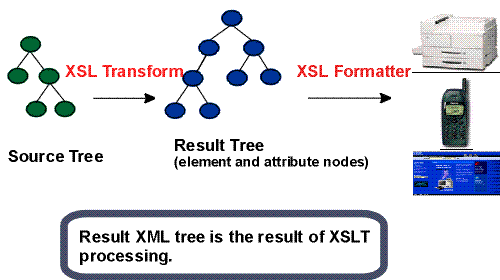
XSL Two Processes: Transformation & Formatting Tree Transformations[top]Tree TransformationsTree transformation constructs the result tree. In XSL, this tree is called the element and attribute tree, with objects primarily in the "formatting object" namespace. In this tree, a formatting object is represented as an XML element, with the properties represented by a set of XML attribute-value pairs. The content of the formatting object is the content of the XML element. Tree transformation is defined in the XSLT Recommendation [XSLT] . A diagram depicting this conceptual process is shown below. 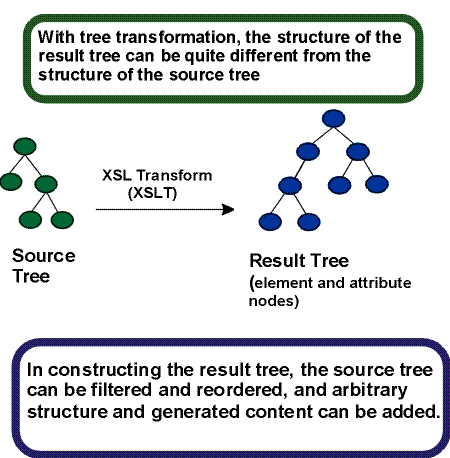
Transform to Another Vocabulary The XSL stylesheet is used in tree transformation. A stylesheet contains a set of tree construction rules. The tree construction rules have two parts: a pattern that is matched against elements in the source tree and a template that constructs a portion of the result tree. This allows a stylesheet to be applicable to a wide class of documents that have similar source tree structures. In some implementations of XSL/XSLT, the result of tree construction can be output as an XML document. This would allow an XML document which contains formatting objects and formatting properties to be output. This capability is neither necessary for an XSL processor nor is it encouraged. There are, however, cases where this is important, such as a server preparing input for a known client; for example, the way that a WAP ( [http://www.wapforum.org/faqs/index.htm] ) server prepares specialized input for a WAP capable hand held device. To preserve accessibility, designers of Web systems should not develop architectures that require (or use) the transmission of documents containing formatting objects and properties unless either the transmitter knows that the client can accept formatting objects and properties or the transmitted document contains a reference to the source document(s) used in the construction of the document with the formatting objects and properties. Formatting[top]FormattingFormatting interprets the result tree in its formatting object tree form to produce the presentation intended by the designer of the stylesheet from which the XML element and attribute tree in the "fo" namespace was constructed.
The vocabulary of formatting objects supported by XSL - the set of
The properties associated with an instance of a formatting object control the formatting of that object. Some of the properties, for example "color", directly specify the formatted result. Other properties, for example 'space-before', only constrain the set of possible formatted results without specifying any particular formatted result. The formatter may make choices among other possible considerations such as esthetics. Formatting consists of the generation of a tree of geometric areas, called the area tree. The geometric areas are positioned on a sequence of one or more pages (a browser typically uses a single page). Each geometric area has a position on the page, a specification of what to display in that area and may have a background, padding, and borders. For example, formatting a single character generates an area sufficiently large enough to hold the glyph that is used to present the character visually and the glyph is what is displayed in this area. These areas may be nested. For example, the glyph may be positioned within a line, within a block, within a page. Rendering takes the area tree, the abstract model of the presentation (in terms of pages and their collections of areas), and causes a presentation to appear on the relevant medium, such as a browser window on a computer display screen or sheets of paper. The semantics of rendering are not described in detail in this specification. The first step in formatting is to "objectify" the element and attribute tree obtained via an XSLT transformation. Objectifying the tree basically consists of turning the elements in the tree into formatting object nodes and the attributes into property specifications. The result of this step is the formatting object tree. 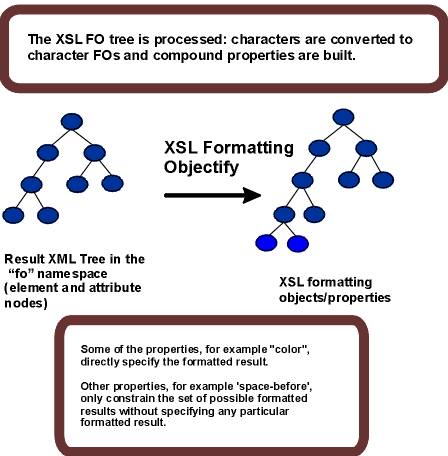
Build the XSL Formatting Object Tree As part of the step of objectifying, the characters that occur in the result tree are replaced by fo:character nodes. Characters in text nodes which consist solely of white space characters and which are children of elements whose corresponding formatting objects do not permit fo:character nodes as children are ignored. Other characters within elements whose corresponding formatting objects do not permit fo:character nodes as children are errors. The content of the fo:instream-foreign-object is not objectified; instead the object representing the fo:instream-foreign-object element points to the appropriate node in the element and attribute tree. Similarly any non-XSL namespace child element of fo:declarations is not objectified; instead the object representing the fo:declarations element points to the appropriate node in the element and attribute tree. The second phase in formatting is to refine the formatting object tree to produce the refined formatting object tree. The refinement process handles the mapping from properties to traits. This consists of: (1) shorthand expansion into individual properties, (2) mapping of corresponding properties, (3) determining computed values (may include expression evaluation), (4) handling white-space-treatment and linefeed-treatment property effects, and (5) inheritance. Details on refinement are found in [refinement] . The refinement step is depicted in the diagram below. 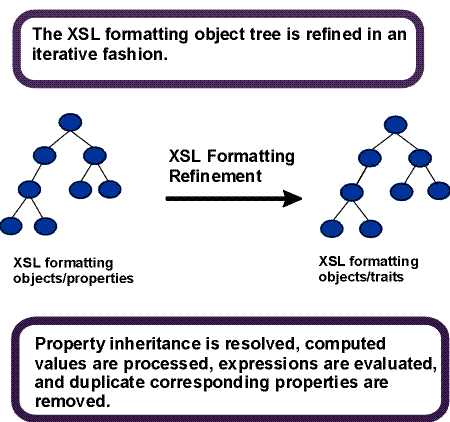
Refine the Formatting Object Tree The third step in formatting is the construction of the area tree. The area tree is generated as described in the semantics of each formatting object. The traits applicable to each formatting object class control how the areas are generated. Although every formatting property may be specified on every formatting object, for each formatting object class, only a subset of the formatting properties are used to determine the traits for objects of that class. Area generation is depicted in the diagram below. 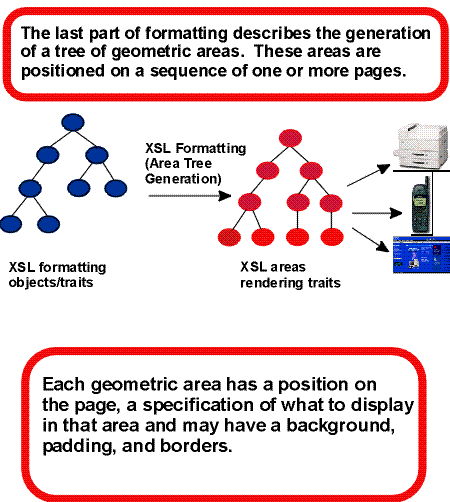
Generate the Area Tree 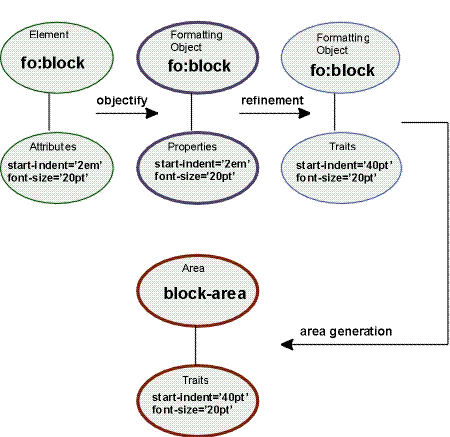
Summary of the Process |